

We know. You opened fourteen tabs, and now they're all arguing with each other.
Which course? Which intake? How much money, exactly? And will the visa be a headache?
Study in New Zealand: Make It Happen. Free Live Webinar, 14 Nov. On Saturday. Kiwiana Immigration is hosting a free live webinar with a Massey University country head and a licensed immigration adviser. Here's what to know before you join, and what to ask.

Courses and intakes: when can you actually start?
New Zealand universities mostly start students twice a year: Semester One in late February and Semester Two in mid-July. Massey also runs a Summer School that begins in November. Those are Massey's own dates for 2024 and 2025, and they shift a little each year. Not every programme starts in every semester, so check the course page for yours. (Massey key dates)
Here's why that matters. Say you finish your bachelor's in May and want a July start. The University of Auckland advises applying for your student visa about three months before you travel. Count back from July and you're looking at April. Miss that, and February next year is the realistic option. (University of Auckland)
New Zealand has eight public universities, and Massey is one of them. It ranks 215 in the QS World University Rankings 2027 and teaches across Palmerston North, Auckland and Wellington. Courses can differ by campus, so ask which campus yours is on. (Leap Scholar)
Pick the course first and the ranking second.
The visa process, step by step
Most students apply under the Fee-Paying Student visa. The steps below come from the University of Auckland's guide for new students and Immigration New Zealand's funds page. Your own case may differ, so treat this as a map, not advice. (University of Auckland, Immigration NZ)
1. Get your offer of place. You can apply from outside NZ with a conditional offer, but you need an unconditional one before the visa is granted.
2. Sort the tuition. Pay your first year's tuition, including insurance fees. If you apply from outside NZ, you can wait until INZ approves your application in principle, then show proof of payment.
3. Show your living funds. That's NZ$20,000 for each year of study, or NZ$1,667 a month for shorter study. You also need money for a ticket home.
4. Gather the paperwork. You may need a chest x-ray or medical certificate, and police certificates.
5. Write your statement of purpose. Explain why you chose this course and how you'll pay for it.
6. Upload your photos and documents, then apply online.
Two small things trip people up. INZ doesn't accept screenshots of bank transfers or education agent receipts as proof of funds. It wants bank statements with your name and the last three months of transactions. And deposits over NZ$2,000 may need explaining, so start saving statements early rather than moving money in at the last minute. Photos must also be natural and unedited, and the University of Auckland's guide says AI enhancement isn't allowed.
Meeting every requirement doesn't guarantee approval. INZ makes that decision.
Costs and work rights: the honest numbers
Tuition varies a lot by course and university, so no single number is right for everyone. Check your university's own fee page for the exact figure.
Here's how the budget adds up, using a made-up tuition fee of NZ$40,000 purely to show the sums. It isn't a Massey quote.
What you pay or show
Example
First year’s tuition (illustration only): NZ$40,000
Living funds INZ wants to see: NZ$20,000
Money for a ticket home: the price of one flight
That's roughly NZ$60,000 before the flight, ready in your account or covered by a loan or scholarship. INZ accepts bank statements, term deposits held for at least three months, scholarship letters and education loan letters from qualifying banks. (Immigration NZ)
Work rights are the second half of the money question. Students on eligible visas can work up to 25 hours a week during term. That's rent-and-coffee money and real experience, not a salary, so don't plan to pay tuition from it. After you finish, a masters graduate can apply for a Post Study Work Visa of up to three years, depending on the qualification. (BAL, Envoy Global)
Check the conditions on your own visa before you take any job.
Two days after the webinar, the rules change
Timing's good here. On 16 November 2026, New Zealand's post-study work rules shift. (Migration Overseas, IIA roundup)
• A full-time Level 7 Graduate Diploma now qualifies for a Post Study Work Visa, if you also hold a bachelor's degree. The visa lasts as long as you studied the diploma, up to one year.
• A new Short-Term Graduate Work Visa gives six months of work rights to graduates of Level 5 to 7 courses who don't qualify for a Post Study Work Visa. You need at least 24 weeks of full-time study in NZ and NZ$5,000 in funds, and you must apply within three months after your student visa ends. It can't be extended.
• Masters and doctoral graduates still get up to three years. Indian citizens who finish a doctorate in NZ get four.
The 25-hour weekly work limit isn't part of this change.
These rules are new, so details can still be clarified. Ask about them live and check Immigration New Zealand's website before you act.
Meet your speakers
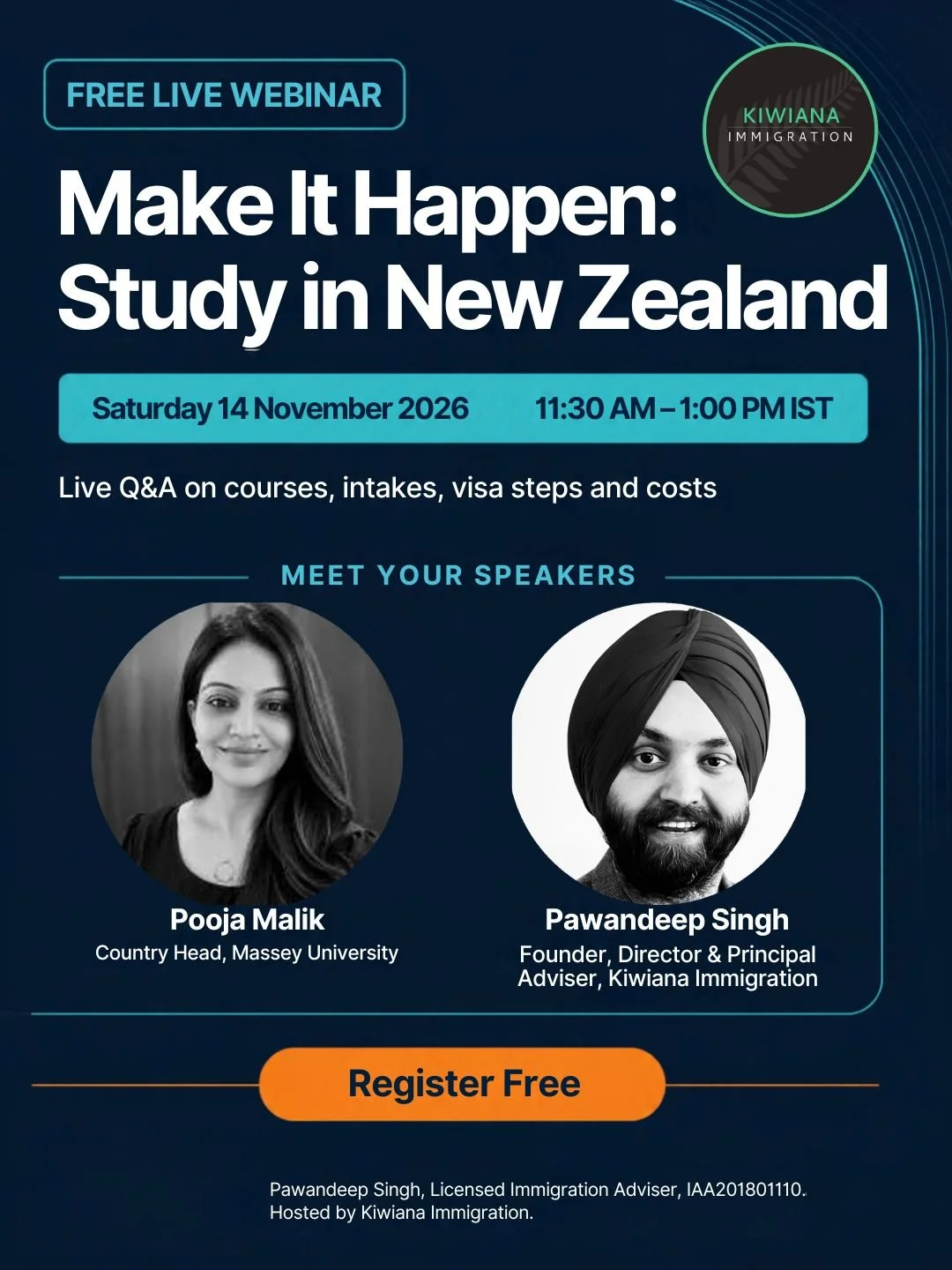
Pooja Malik, Country Head, Massey University. She brings the university side: courses, intakes and what studying at Massey looks like.
Pawandeep Singh, Founder, Director and Principal Adviser, Kiwiana Immigration. He's a Licensed Immigration Adviser (licence number IAA201801110) and covers the visa steps, costs and work rights. In New Zealand, anyone giving immigration advice must be licensed or exempt, and the Immigration Advisers Authority keeps a public register you can check. (IAA register)
It's a live Q&A, so bring your questions.
Webinar details
Event: Make It Happen: Study in New Zealand
Date: Saturday 14 November 2026
Time: 11:30 AM to 1:00 PM IST (7:00 to 8:30 PM in New Zealand)
Cost: Free
Format: Live webinar with Q&A
Topics: Courses and intakes, visa steps, costs and work rights
Hosted by: Kiwiana Immigration
Register: Register free here
FAQs: study in New Zealand and the webinar
Is the webinar really free? Yes. Registration is free, and so is the live Q&A.
Who is it for? Students, graduates and parents who are thinking about studying in New Zealand and want straight answers on courses, intakes, visa steps, costs and work rights.
How early should I apply for a student visa? The University of Auckland advises about three months before you travel. Apply with every document ready, because incomplete applications get delayed and may be declined. (University of Auckland)
How much money do I need to show? NZ$20,000 for each year of study for living costs, plus your tuition and money for a ticket home. (Immigration NZ)
Can I work while I study? Up to 25 hours a week during term on eligible student visas. Check your own visa conditions. (BAL)
Will attending guarantee me a visa or a job? No. Nobody can promise that, and you should be wary of anyone who does. The webinar helps you plan with accurate information. INZ decides visa applications.
Ready to make it happen?
No pressure and no sales pitch needed. If you're even a little curious about studying in New Zealand, an hour and a half with the right people will save you a lot of tab-hopping.
Saturday 14 November, 11:30 AM to 1:00 PM IST. Free and live. [Register free here) and bring your questions.
Can't make it, or still not sure? Tell us your biggest study-abroad fear in the comments. Money, visas, loneliness, landing a job? We'll tackle it in a future post. Or subscribe to our weekly newsletter and get one clear, jargon-free takeaway a week.
